


Op-Ed: Save Our Bacon Act Threatens Farmers, Consumers, and Food Safety
Updated: Jul 17
Published as a Guest Column in the July 12, 2026 Cedar Rapids Gazette
by Diane Rosenberg | Executive Director
The long-awaited Farm Bill is now moving forward, but so is the possible inclusion of the EATS/Save Our Bacon (SOB) Act, introduced last year by Senator Joni Ernst and Representative Ashley Hinson.
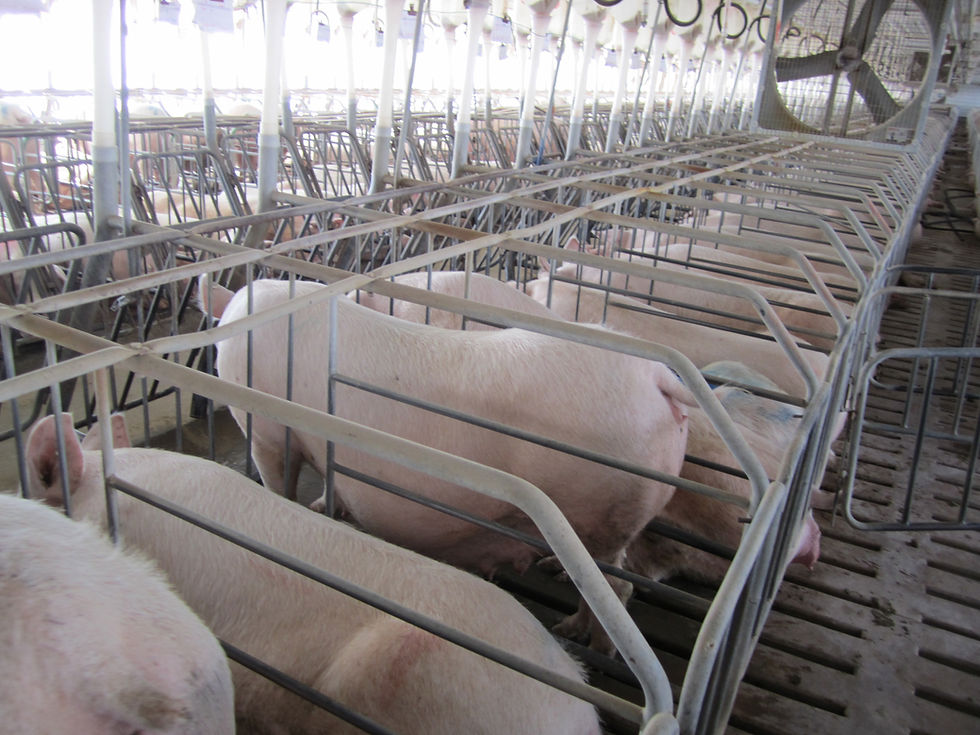
The EATS/SOB Act would nullify California Proposition 12, passed in 2018 with 63% of California voters. Prop 12 requires pork products sold – in that state only – to be raised in gestation-free crates.
The House version of the Farm Bill contains the unpopular EATS/SOB language. The Senate version released doesn’t. However, the EATS/SOB Act is cosponsored by all Iowa legislators, and Senators Chuck Grassley and Ernst are signaling they intend to ram it through as a Farm Bill amendment or through reconciliation.
Critics of Prop 12 claim the measure creates uncertainty, threatening the pork industry and consumers.
Big Pork, as you’ll read in a moment, is doing quite well.
Let’s be clear. No farmer is forced to comply with Prop 12. In a July 14, 2024 Cedar Rapids Gazette article, Iowa Pork Producers Association president Matt Gent said, “there’s been enough production change to meet Prop 12 demand that it really truly doesn’t affect a producer that doesn’t want to” change their operation.
In fact, with 11% of the world’s market, the US pork industry is a global powerhouse. The industry is expected to increase production in 2026 to nearly 28 billion pounds, a 1.5% increase over 2025. Iowa’s national market share of US production dominates at about 30%. The export market is robust with the US exporting nearly 30% of its total pork production in 2025. Iowa, too, remained the nation’s top exporter in 2025 at $2.1 billion.
The industry isn’t suffering under the weight of Prop 12. Let’s put that argument to rest.
What the EATS/SOB Act does do is threaten independent family farmers who now have access to more diverse markets and penalizes farmers who invested to meet Prop 12 standards.
Especially concerning is the threat to food safety and security. Harvard University Law School issued a revised legislative analysis last September that found 600 state laws protecting the nation’s food supply would be struck down if the EATS/SOB Act passed.
In Iowa, the EATS/SOB Act would nullify 14 laws that protect livestock health through importation requirements and testing for highly pathogenic avian influenza (HPAI), tuberculosis, brucellosis, trichomoniasis, and others. Losing livestock to these diseases would be economically devastating for Iowa farmers and threaten food security.
One such law, Iowa Administrative code r.21-65.11, protects poultry farmers by mandating a veterinary inspection certificate for all poultry, domestic fowl, and hatching eggs imported into Iowa to prevent the spread of HPAI. This year, Iowa farmers already lost six flocks to HPAI, and the average cost of outbreaks to Iowa farmers in 2022-2024 was $3.7 million. Iowa farmers need the protection of these laws.
Nationally, the EATS/SOB Act would prevent states from passing laws protecting against the spread of the recently reemerged and potentially devastating New World screwworm.
It’s farmers and consumers who would pay the price for this short-sighted law.
And for whom? Chinese-owned Smithfield Foods, which controls 25% of the US pork market, is driving passage of this bill. China has no livestock protections, and hogs are often crammed into high-rise confinement buildings. Smithfield want to raise hogs in the US with as few animal welfare restrictions as possible
The EATS/SOB Act is so harmful that Senator Roger Marshall (R-KS), an original sponsor and vocal proponent of the bill, recently withdrew his support and name from the proposed legislation.
Doesn’t that tell you something?
The big question then becomes, why are Iowa legislators intent on passing it?
------


Bài viết này gọn gàng, nói đúng ý nên mình đọc cái là nắm được ngay, cảm ơn bạn đã chia sẻ. Mình cũng có thói quen xem thống kê XSMB mỗi ngày, nhưng hồi trước phải mở nhiều nơi để đối chiếu nên hơi mất công. Về sau mình tự gom lại cho dễ theo dõi, kiểu lưu thành ghi chú trên một trang ở soicau247.com để lúc cần chỉ mở ra xem nhanh. Mục đích của mình chỉ là có số liệu cập nhật theo ngày để so sánh cho tiện, chứ không làm gì phức tạp hay cầu kỳ. Nếu ai cũng hay xem rồi muốn lưu lại cho đỡ rối, thì mình để đường dẫn mình…